VinylPlus Healthcare is helping hospitals and the medical value chain turn clean, non-contaminated vinyl medical devices into a resource for new products.
Many PVC medical devices are used in controlled healthcare settings and remain suitable for recycling after use. Yet today, much of this high-quality material is still sent to incineration or waste-to-energy. By improving source separation, collection, dismantling and recycling, VinylPlus Healthcare supports a more circular approach to healthcare plastics – without compromising patient safety or hospital efficiency.

Building Practical Recycling Models
Building on practical experience from Belgium and current activities in France, VinylPlus Healthcare works with hospitals, medical device companies, circular economy specialists, waste operators and recyclers to develop practical recycling models for selected PVC medical device streams.
In France, the programme is being developed together with Terra, with collection already taking place at hospital level and further expansion planned with additional healthcare and medtech partners.
The earlier Belgian programme provided valuable practical experience in the collection, sorting, dismantling and recycling of non-contaminated medical vinyl waste, which is helping inform the development of future recycling models
Tackling Medical Plastic Waste Through Circularity
Vinyl (PVC) is the most widely used plastic in single-use medical devices, including oxygen masks, tubing, and IV bags. While essential for patient care, a significant portion of this waste remains clean and non-contaminated—yet most of it is still incinerated or sent to waste-to-energy facilities.
European healthcare systems contribute 5–10% of national carbon footprints, with medical devices and pharmaceuticals accounting for nearly half. Addressing waste at the source—by improving sorting between infectious and non-infectious materials and prioritising mechanical recycling for highly recyclable vinyl—is increasingly recognised as a key decarbonisation strategy.
Advanced recycling technologies, including dissolution-based and chemical recycling, are being developed to complement mechanical recycling where needed.
The Circular Journey of Medical Vinyl
The high-quality, colourless medical vinyl waste collected at hospitals follows a structured recycling process, ensuring that valuable material is transformed into new, durable products.
After use, non-contaminated vinyl medical devices are collected in dedicated bins throughout participating wards and transported to a specialised dismantling partner, where non-vinyl components are removed before the clean vinyl is sent for recycling.
The material is then processed into high-quality recyclate, which is used to produce long-lasting healthcare interior applications such as flooring.
Step-by-Step: The VinylPlus Healthcare Recycling Process

USE OF MEDICAL DEVICE
The medical device is used by patients for elective surgery and other treatments where the waste remains non-contaminated.

COLLECTION
Filled bins provided by VinylPlus Healthcare are collected by waste management companies.
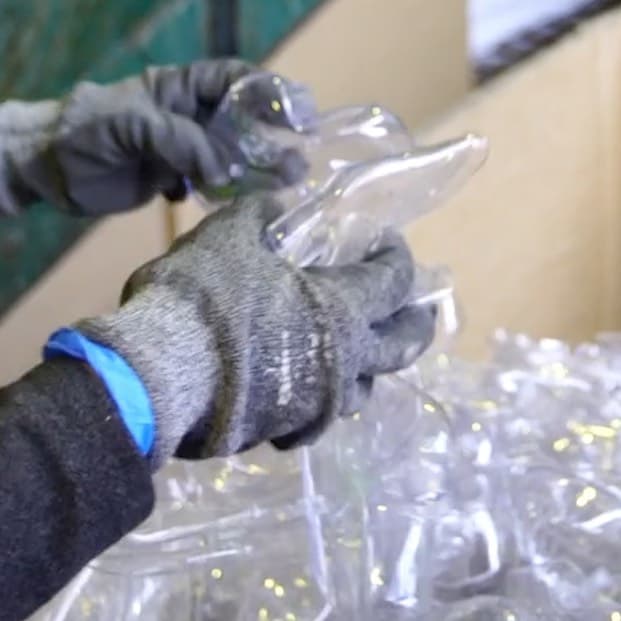
DISMANTLING
Our social partner dismantles the devices, removing non-vinyl parts.

RECYCLING
Our recycling partners process the waste.
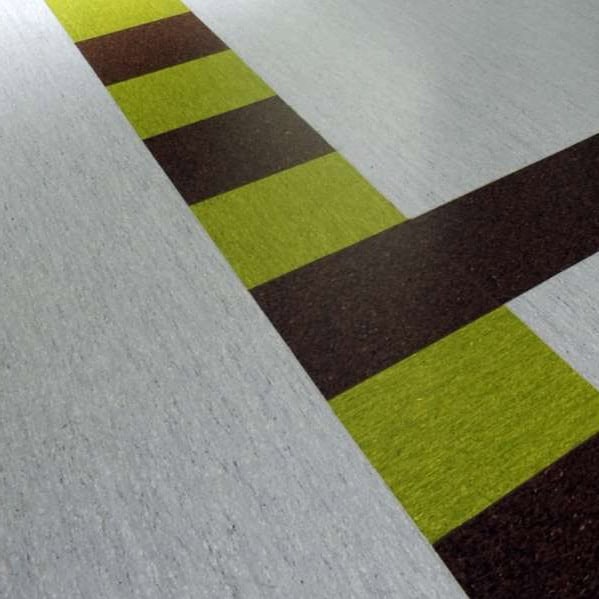
USE OF RECYCLED VINYL
The recycled vinyl is used for hospital interior applications such as flooring.
Full Recycling Process (3 min)
Recycling Process in 36 Seconds
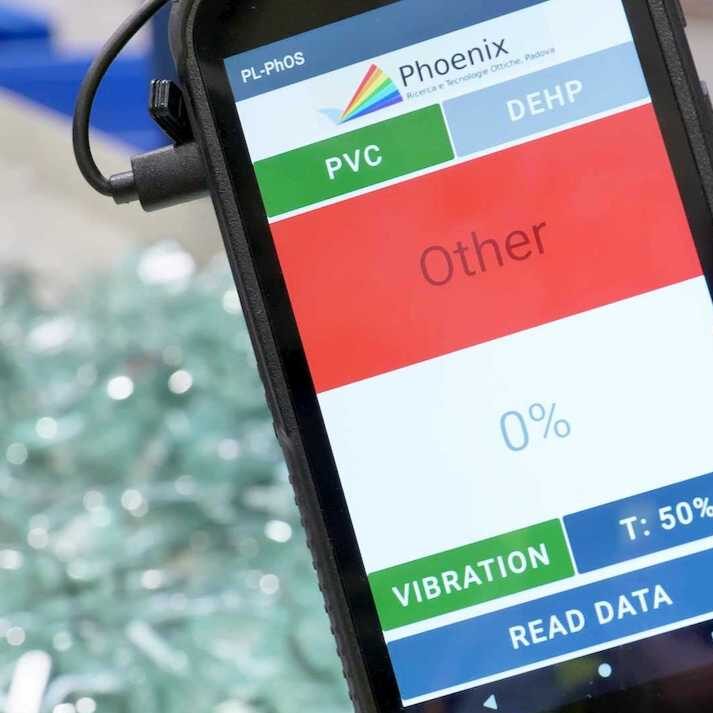
Smart Scanner Ensures Only REACH-Compliant Waste is Recycled
It is crucial for the success of VinylPlus Healthcare's recycling activities that only REACH-compliant, DEHP-free vinyl is recycled. To meet this objective, a cost-efficient portable near-infrared (NIR) scanner has been developed by the European vinyl industry.
The scanner, which uses artificial intelligence (AI) to detect the presence of vinyl (PVC) and DEHP in waste streams, is currently being improved and scaled up to enhance its accuracy and efficiency. The long-term plan is to integrate the scanner into recycling plants, ensuring an automated and streamlined sorting process for medical and other flexible vinyl waste streams.
Third-Party LCA Documents Significant CO2 Reductions From Mechanical Recycling
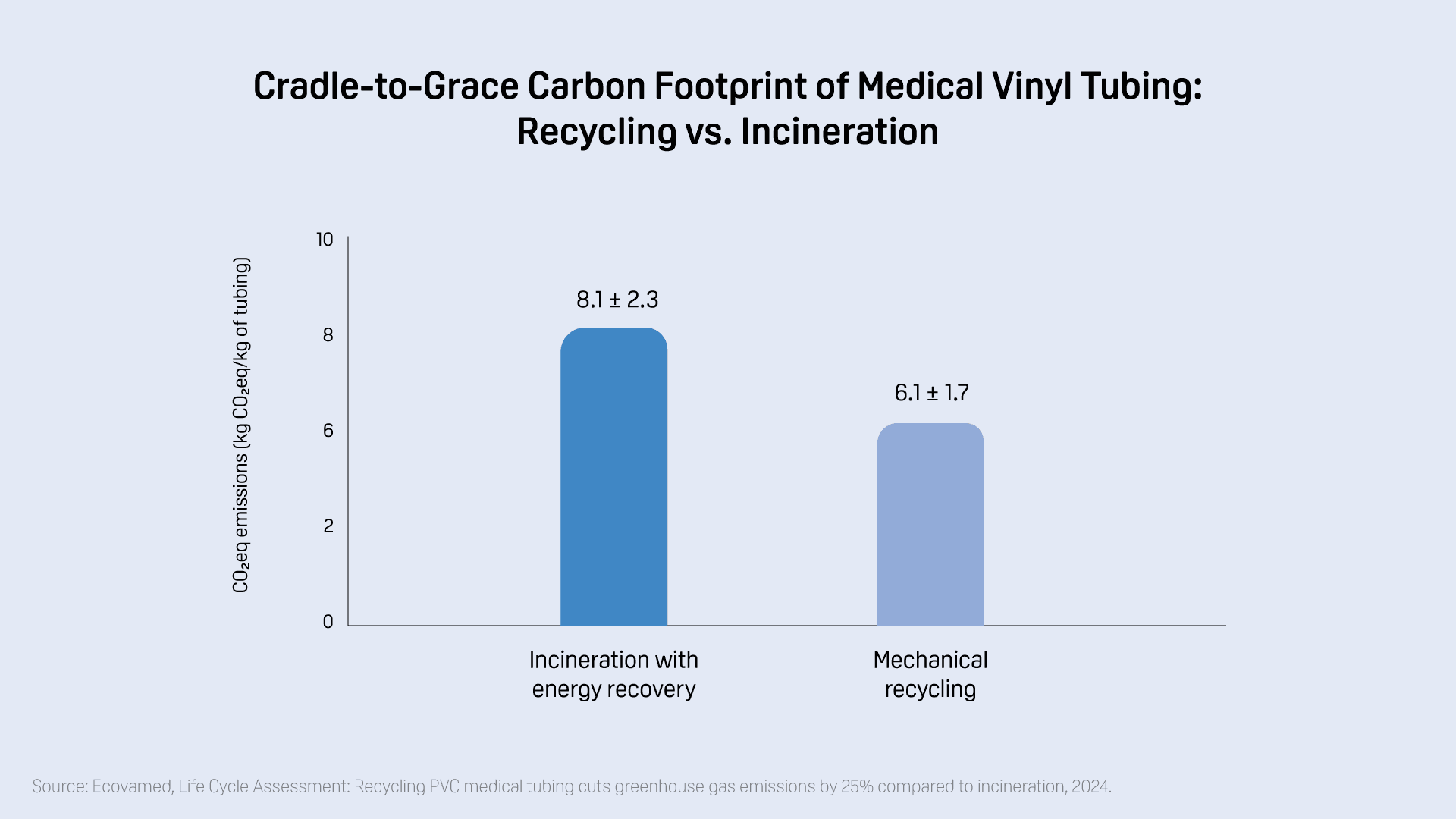
To quantify the carbon savings achieved through VinylPlus Healthcare's recycling efforts, French consultancy Ecovamed conducted a Life Cycle Assessment (LCA) on vinyl-based medical tubing in Europe. This assessment followed the GHG Protocol standard and compared two end-of-life scenarios for medical tubing:
- Incineration with energy recovery and acid flue gas treatment
- Mechanical recycling in Belgium, with an 80% material yield, producing wall coverings from the recovered vinyl.
The LCA found that, on a cradle-to-grave basis, mechanical recycling reduces greenhouse gas emissions by 25% compared to incineration, equivalent to 2.0 kg CO₂eq avoided per kg of tubing. If the recycled vinyl were fully utilised in other applications with higher vinyl content, the potential CO₂ savings could be significantly higher than those currently calculated.
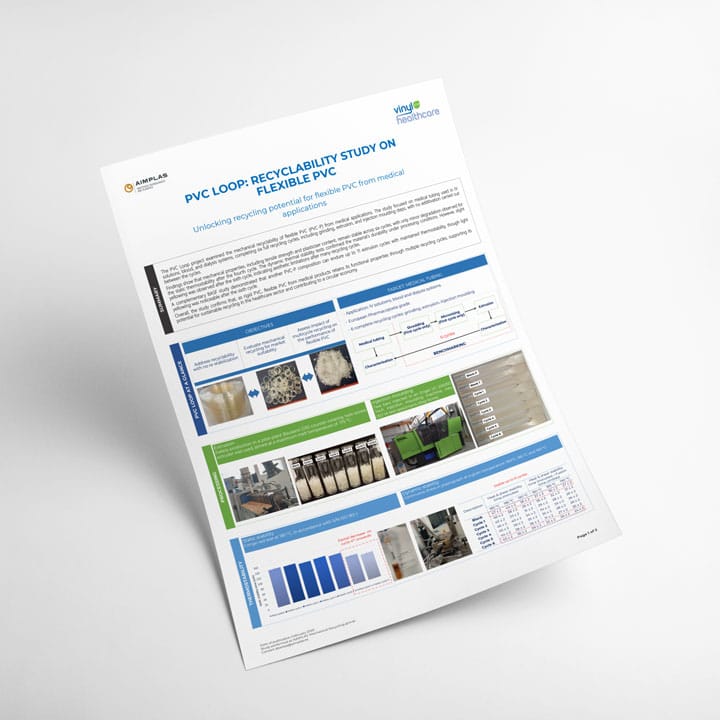
Third-Party Study Confirms: Medical PVC Can Be Recycled Multiple Times
What They Say About Us
Ghent University

VinylPlus Med mentioned as an example of already existing initiatives in Belgian hospitals to collect and recycle disposables.
BX1

CHU St Pierre announced that the hospital could collect 150 kg PVC in 3 months and that VinylPlus Med will be applied in all departments by end-2023.
Inovyn Awards 2022

Bronze in Circularity category: VinylPlus for its ‘collection and recycling process targeting non-infectious PVC medical consumables’

Le recyclage des déchets hospitaliers en PVC prend son envol en Belgique: “Notre hôpital est, comme bien d’autres, un gros pollueur.”
Le PVC est le plastique le plus largement utilisé dans les dispositifs médicaux jetables: masques, tubulures… Le projet VinylPlus Med, qui vise à trier les applications médicales en PVC pour les recycler, vient d’être lancé chez nous. Objectif : 1000 tonnes par an!

Trends/Tendances

VinylPlus Med, un projet commun de recyclage des déchets médicaux en équipement hospitalier.
Trois structures unissent leurs forces pour accroître la durabilité dans le secteur des soins de santé en Belgique. A terme, le projet collaboratif VinylPlus Med devrait permettre d’éviter l’émission de 2.000 tonnes de CO2 par an grâce au recyclage des déchets médicaux.