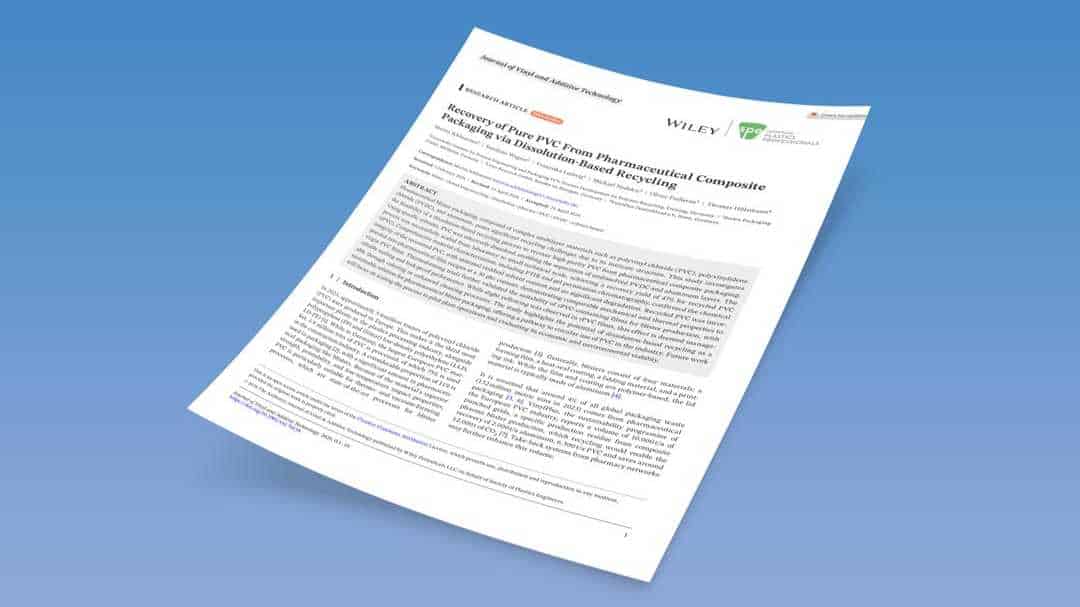

A peer-reviewed scientific article developed as part of the VinylPlus® PharmPack project has confirmed the technical feasibility of recovering high-purity recycled PVC from pharmaceutical blister packaging using dissolution-based recycling.
Pharmaceutical blister packaging is typically composed of several tightly bonded material layers, including PVC, PVDC and aluminium. This complex structure provides important barrier properties for medicines but also makes recycling technically challenging.
The study investigated how a dissolution-based process can selectively dissolve the PVC layer, enabling separation from undissolved PVDC and aluminium. The process was successfully scaled from laboratory to small-technical scale and achieved a recovery yield of 47% recycled PVC.
Comprehensive material testing confirmed that the recovered PVC retained its chemical integrity, with minimal residual solvent content and no significant degradation. The recycled PVC was then incorporated into pharmaceutical film formulations and tested in thermoforming trials.
The results showed that films containing recycled PVC had mechanical and thermal properties comparable to virgin PVC films. Thermoforming trials also demonstrated reliable sealing and leak-proof blister performance.
The article provides important scientific validation for the VinylPlus® PharmPack project’s work to develop circular pathways for PVC pharmaceutical blister packaging in Europe. It shows that advanced physical recycling technologies such as dissolution can help recover valuable materials from complex multilayer packaging while preserving polymer quality.
Future work will focus on further scaling the process and assessing its economic and environmental viability.